
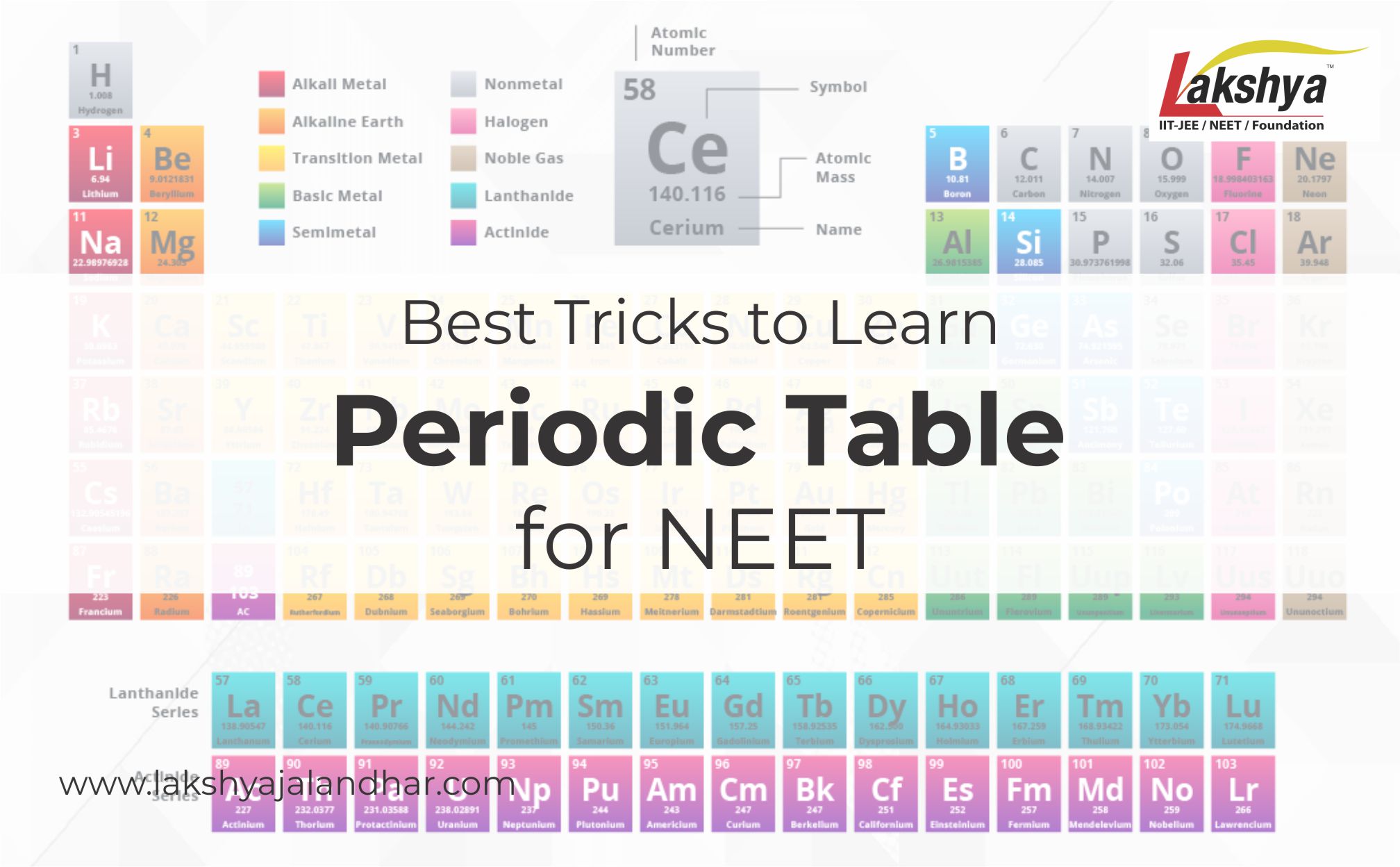
Best Tricks To Learn The Periodic Table For NEET
The NEET preparation process is not complete without the periodic table, which serves as the cornerstone of chemistry. Having a strong understanding of the periodic table can potentially assist you in solving difficult problems and gaining an awareness of the properties of chemicals. A thorough grasp of the periodic table is crucial for any subject, including inorganic chemistry, physical chemistry, and even some areas of biology. However, learning more than 100 elements, their symbols, atomic numbers, and trends by heart might be daunting for a lot of students. Using the best tricks, patterns, and regular revision procedures is more important for understanding the periodic table than naive memorization.
In this article, we will explore some of the best tricks and methods that will help NEET aspirants to learn the periodic table in a structured, efficient, and long-lasting way.
If you are also preparing for the NEET exam and seek expert guidance, then you can enrol in Lakshya Institute in Jalandhar.
Best Tricks And Methods To Learn The Periodic Table For Neet
Here are some of the best tricks and methods that will help NEET aspirants to learn the periodic table for the NEET:
Understand the logic behind the periodic table
Before making any attempt to memorize anything, it is necessary to have a solid understanding of the structure of the periodic table. Periods (rows) and groups (columns) are used to organize the elements in the periodic table, which is structured according to increasing atomic number. The electronic configurations of the elements are used to determine the arrangement of the elements.
Learning to memorize information is made much easier when one is aware of the reasoning behind the arrangement of the pieces. One example of this is that atoms that belong to the same group have chemical properties that are equivalent to one another since they have the same number of valence electrons. When patterns like this are discovered, it is much simpler to commit specific attributes to memory.
Break the table into smaller blocks
Instead of attempting to learn the entire elements of the periodic table all at once, break it up into more manageable sections:
- s-block elements (Groups 1 and 2)
- p-block elements (Groups 13 to 18)
- d-block elements (Transition metals)
- f-block elements (Lanthanides and Actinides)
Focus on mastering one block at a time. This segmented approach makes the learning process less intimidating and more organized. Start with the s-block and p-block since they are heavily emphasised in NEET.
Use mnemonics for easy recall
Memory aids known as mnemonics can be used to simplify even the most challenging sequences. Mnemonics are useful in helping people remember information. One way to make it simpler for yourself to remember element sequences is to create sentences that are either funny or meaningful.
For example:
- Group 1 elements: “Happy He Likes Beer But Could Not Obtain Food” (H, Li, Na, K, Rb, Cs, Fr)
- Group 2 elements: “Be My CaR, Sr. BaRa” (Be, Mg, Ca, Sr, Ba, Ra)
In addition, you have the ability to create your own personalized mnemonics, which are often more effective because they are meaningful to you.
Practice writing the periodic table regularly
The periodic table can be written multiple times, which is one of the approaches that is both the easiest and most efficient. At the beginning of each day, write down the first twenty items, and then gradually add more later on.
Through the utilization of muscle memory and active recall, this method assists in the enhancement of retention. At some point in the future, you will be able to recreate substantial chunks of the periodic table in a straightforward and speedy manner.
Focus on periodic trends instead of isolated facts
While it is true that committing individual values to memory is important, it is substantially more beneficial to understand trends. The following are some of the key recurrent patterns:
- Atomic radius
- Ionization energy
- Electronegativity
- Electron affinity
- Metallic and non-metallic character
For example, atomic size increases down a group and decreases across a period. Once you understand this, you do not need to memorize the size of each element individually.
Use visual learning techniques
The power of visual memory cannot be overstated. Make use of the following resources:
- Wall charts of the periodic table
- Colour-coded tables for different blocks
- Highlighting important groups and trends
Keeping a chart of the periodic table in front of your study desk ensures that you will be exposed to it continuously, which is beneficial for the development of subconscious learning.
Learn through songs and rhythms
Listening to music is one of the most effective ways to boost one’s memory. Many of the students are able to retain the periodic table with the assistance of songs and rhythmic recitation. These strategies make it possible to retain information more quickly and with greater pleasure by utilizing auditory memory.
Alternatively, you can look up tunes from the periodic table on the internet or create your own song.
Use flashcards for quick revision
Flashcards are tremendously effective when it comes to active recall. With the name of the element written on one side, the symbol, atomic number, and key features of the element should be written on the other side.
You should review these cards on a regular basis, particularly during small breaks. When it comes to updating atomic numbers, groups, and exceptions, this approach performs exceptionally well.
Practice MCQs and previous year questions
The application of knowledge is the key to mastery. There are several advantages to answering multiple-choice questions at the NEET level:
- Reinforce concepts
- Improve speed and accuracy
- Identify weak areas
On account of the fact that many of the questions on the NEET are based on periodic trends and traits, regular practice will help you improve your comprehension.
Revise consistently
Revision is the first step in the formation of long-term memory. If they are not reviewed consistently, even well-learned subjects will gradually become less relevant. Observe a revision schedule such as the following:
- Daily quick revision
- Weekly detailed revision
- Monthly full revision
You are better able to remember information if you repeat it at regular intervals.
Connect with real-life applications
In order to make elements easier to recall, it is possible to tie them to certain practical applications. Take, for example:
- Sodium (Na) is used in street lights
- Iron (Fe) is used in construction
- Oxygen (O) is essential for respiration
As a consequence of these connections, learning becomes less abstract and more meaningful to the learner.
Focus more on important elements
There are some components that are more important than others for NEET. A closer look should be taken at:
- First 30 elements
- Common transition elements
- Important p-block elements like C, N, O, F, Cl
The use of this targeted strategy ensures efficient management of time.
Avoid overloading yourself
When you try to learn everything at once, you run the risk of becoming extremely exhausted and misunderstanding everything. Ensure that your study sessions are manageable and provide you with a clear focus. Consistency is more important than intensity in this context.
Study with friends or teach others
As a learning method, teaching is among the most effective approaches. Providing a friend with an explanation of periodic trends or the characteristics of elements can help you improve your own grasp. The introduction of fresh viewpoints and methods of recollection can also be accomplished through the use of group talks.
Stay patient and consistent
Learning the periodic table is a process that takes some time. Perseverance, practice, and patience are all necessary components. Although it is a natural part of the learning process, you should not give up if you initially forget anything.
Conclusion
Achieving proficiency in the National Eligibility and Eligibility Test (NEET) necessitates a robust comprehension of the periodic table, a challenge that can be surmounted. Through a thorough understanding of its fundamental concepts, regular practice, and the utilization of Best Tricks to learn the periodic table for NEET, innovative memory strategies such as mnemonics and visual tools, students can convert the periodic table into a manageable and rewarding area of study.
Understanding and being able to use what you know are just as important as remembering facts. As you practice, you’ll become more skilled with the periodic table, which will help you feel more confident and improve your chemistry skills. To do well on the NEET, you need to be disciplined, keep reviewing, and trust the process.
